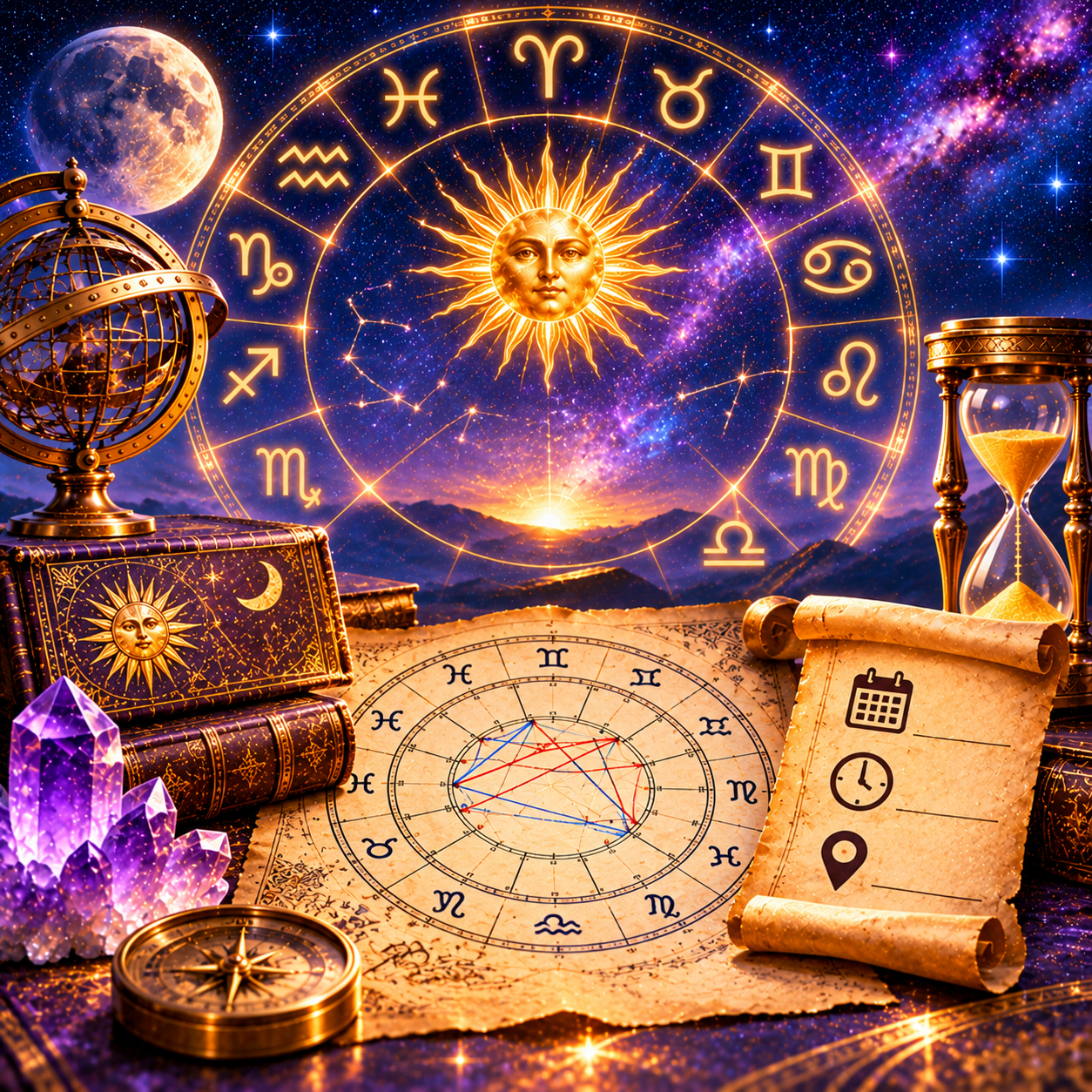
The native map, also called the native horoscope or native theme, is a diagram of the sky as it looked at the time and place of your birth. It is not a decorative drawing: it is an astronomical calculation, to which a symbolic interpretation system is added. If you ever saw a circle divided into 12 sectors, with symbols of planets and colored lines between them, you saw a native map.
This guide explains what a map contains, what data you need to ask for or calculate it, what happens if you don’t know the time of birth and how to read a map without taking it as a verdict. You will also find out where astronomy stops and where interpretation begins.
What exactly is a birth map?
A native map is a snapshot of the sky. It shows what zodiac sign each planet was in at the time of birth, what section (house) of the local sky was in and what angles the planets formed between them. The outer circle is the 360 degree zodiac, divided into 12 30 ° signs. The inner circle is divided into 12 houses, which depend on the time and place of birth.
The position of planets in the zodiac is the same for all those born at the same time anywhere on Earth. Casa și ascendant are those that differ according to place. That’s why two people born simultaneously in cities far apart have the same planets in the same signs, but ascending and different houses.
What the map is made of
Heavenly bodies
An ordinary map includes the Sun and Moon (called “lights”), Mercury, Venus, Mars, Jupiter and Saturn, and in modern astrology and Uranus, Neptune and Pluton. Many maps also show the lunar nodes, a point calculated from the moon’s orbit, sometimes the Chiron asteroid. Nodes are not physical bodies, but geometric points.
Zodiac signs
Every body is in a sign. When someone says “I’m Aries,” it refers to the position of the Sun. The rest of the planets have their own signs, which is why a map has much more information than the newspaper horoscope. The difference between the three basic landmarks is explained in the article on zodiac, ascending and sign of the Moon.
Houses
The 12 houses divide the local sky into sectors. Each house is symbolically associated with an area of life: identity, money, communication, family, relationships, work and so on. There are several methods of sharing, which you read about in the guide of astrological homes e.
Issues
Aspects are the angles between planets. The classical ones are the conjunction (0 °), the sextile (60 °), the square (90 °), the trigon (120 °) and the opposition (180 °). Astrologists accept a slight deviation called blind, several degrees. The traditional interpretation considers the trigon and the sextile “harmonious” and the square and the opposition “tense,” but it is a convention, not a law.
Angles
Ascendant (east) and descendant (west), together with the middle of heaven (up) and the bottom of heaven (down), are the four angles of the map. The first of them shall be calculated as described in the step-by-step guide of the ascendant.
What do you need?
| Date | Why does it matter | If missing |
|---|---|---|
| Date of birth | Set the position of the Sun and the slow planets | Can’t calculate anything |
| Time of birth | Set the ascendant, houses and, on the limit, the lunar position | Remains the “no hours” map: planets in signs, no homes and reliable ascendant |
| Place of birth | Latitude and longitude influence ascending and housing; time zone determines universal time | Ascendant cannot be calculated correctly |
The time must be local civilian time by then, including summer time if in force. The maternity programme or birth certificate is the best source. If you give the approximate time, the result will be approximately.
What the calculation in the back looks like
The position of the planets is obtained from tables of ephemeral, calculated from astronomical patterns of their movement. The houses and the ascendant shall be calculated from the local steel time, latitude and inclination of the ecliptic. There is no “opinion” in this part: two correct programs give the same planetary positions, with different seconds of arc.
Differences occur in interpretation and system choices: what method of houses do you use, what blind do you allow for aspects, if you use tropical or steel zodiac (the difference is explained in this Article).
How do you read the map without getting lost
- Start with the three landmarks: Sun, Moon, ascendant.
- Look at the elements and ways: prevailing, missing.
- Note the close points: Small blind ones are considered to be the most pronounced.
- Read the houses as themes, not as predictions: “where does the theme of relationships appear in my life?”
- Keep critical distance: any reading is a point of view, not a sentence.
What can and can’t do a native map
It can provide a symbolic vocabulary for self-reflection, a structure for questions about itself and a cultural story with roots for thousands of years. Can’t predict events, can’t establish guaranteed compatibility with someone and is not a validated psychological test. Scientific research has not found a relationship between the position of planets at birth and the characteristics of the person. If you use it, use it as a story that helps you think of yourself, not as information about the future.
Home map, solar, synastric: what are
- Nital map: sky at birth.
- Solar Revolution: The map calculated for the moment when the Sun returns to its position on the day of birth once a year.
- Sinastria: comparison of two maps used in astrology of relations.
- Transitions: current positions of planets over the home map.
An example of reading, step by step
Let’s get an imaginary map: the sun in Leo, Moon in Pisces, ascendant Capricorn. The first question an astrologer asks is about balance: we have a sign of fire, one of water and one of land. Then they look into what houses the planets fall into. If the Sun falls in the sixth house, the theme of “self-expression” appears symbolically in the area of daily work. If Moon falls into the fourth house, emotional needs relate to family and home.
Then things come up. A square between the Sun and Saturn, for example, is traditionally read as a tension between the desire to shine and a severe inner voice. A trigon between the Moon and Venus is read as an emotional harmony in relationships. Notice that everything we say is a metaphor vocabulary. Two people can read the same map differently, and that’s normal for a symbolic system.
Why don’t all the maps look the same
You can see maps of 10 planets or 20 points. Some astrologers add asteroids, Arab dots or fixed stars. Others use only classical planets, visible to the naked eye: Sun, Moon, Mercury, Venus, Mars, Jupiter, Saturn. There is no official version. For beginners, it is enough to understand planets, signs, houses and major aspects.
How to choose a home map computer
- Let’s ask for date, time and place, not just date.
- Treat summer time and historical time zones correctly, especially for births before 1997.
- To specify the house system and the type of zodiac used.
- Do not promise “exact predictions”: a serious instrument describes its limits.
Frequently asked questions
Can I make the birth map if I don’t know the time?
You can find the positions of the planets in the signs, but not the ascendant and the houses. Many astrologists use a “solar map” with the ascendant in the Aries or with the Sun to the east, but it’s a working convention, not a real map.
Your birth map is changing?
It’s fixed. What moves are transitions, which is today’s planets versus your map.
How exactly is an online computer?
Planets’ positions are usually very accurate. Ascendant depends on the time and place introduced and the way the program treats summer time and historical spurs.
Where do I start if I’m a rookie?
Calculate the ascendant with the instrument on the site, then read about the three landmarks and about the 12 zodiac signs.
Astrology is a symbolic system, not a science. The information here is educational and does not replace the advice of a specialist.