
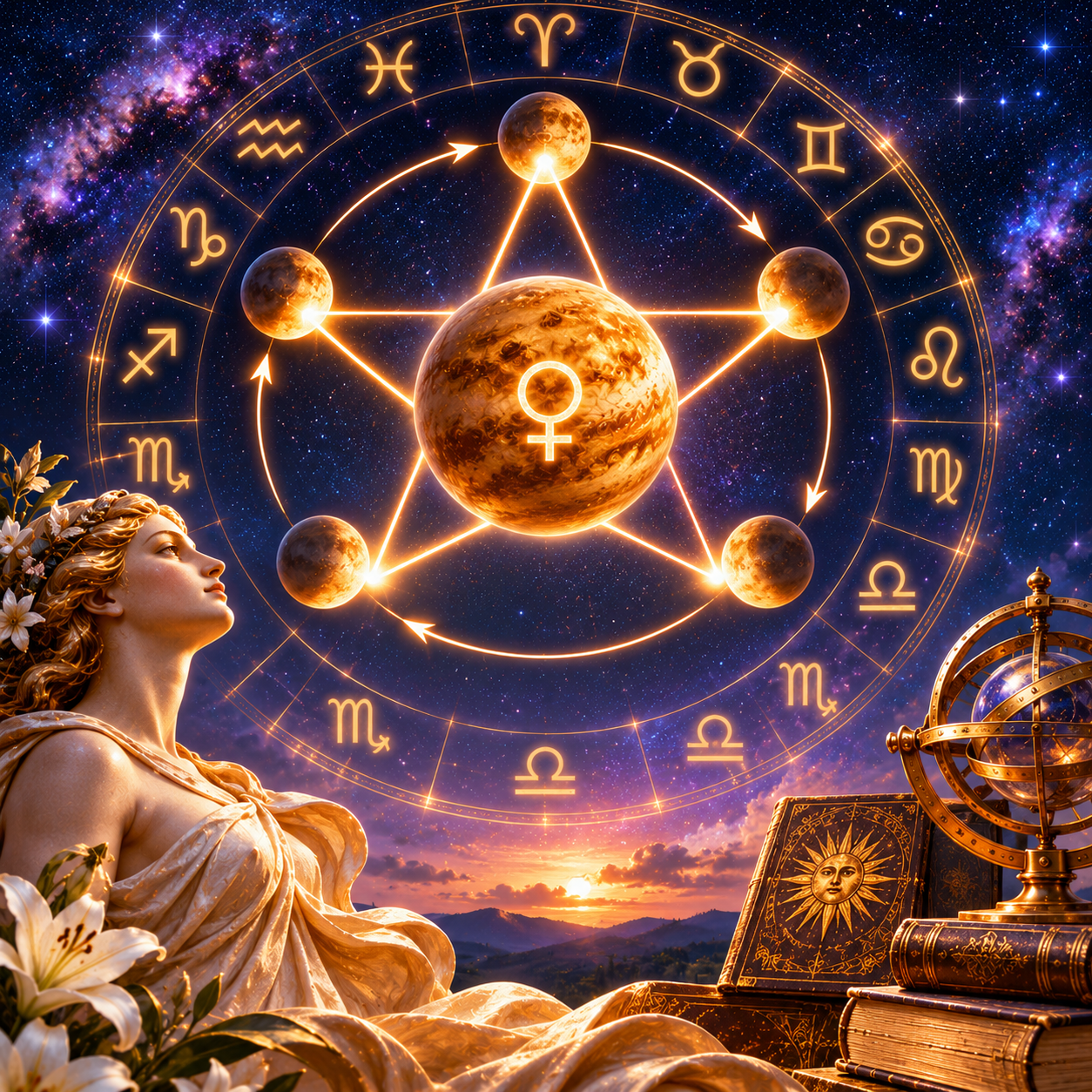
Venus is the brightest star in the sky after the Sun and the Moon, and its movement follows a pattern so regular, that if you mark on a map the places where the “meeting” takes place with the Sun, you get a figure with five corners. Many call it the Venus pentagram or the Venus flower. It’s not a legend: it’s a mathematical consequence of the planet’s motion periods.
The guide explains why Venus has an eight-year cycle, how the pentagram appears, why Venus is when “evening lumber,” when “morning,” what astrologers do with these moments and how you can check the calculations yourself. The astronomical side is accurate; the interpretations are symbolic.
Venus from Earth
Venus orbits the Sun in approximately 224.7 days, faster than Earth. Being closer to the Sun, it never goes far from it in the sky: at most approximately 47-48 °. That’s why we see her either in the evening, after sundown, as an “evening lumber,” or in the morning, before sunrise, as a “morning lumber.” You never see her at midnight.
Synodic period: 584 days
The interval between two successive sun-venus-Earth alignments, of the same type, is called the synodic period. Venus is about 583.9 days, which is about 19 months. The calculation is simple: Earth takes a tour in 365.25 days and Venus in 224.70 days. The angular speed of Venus is 360 ° / 224.7 × 1,602 ° per day and of Earth 360 ° / 365.25 × 0,986 ° per day. Venus earns 0.616 ° per day, so “catch up” the Earth in a full tour (360 °) after 360 / 0.616 is 584 days.
Why do five corners appear
Five synodic periods are 5 × 583.9 = 2 919.5 days, i.e. almost 8 years (8 × 365.25 = 2 922 days). In other words, after eight years, Venus is again, almost exactly, in the same place as the Sun and Earth. Meanwhile, each lower conjunction (when Venus passes between the Earth and the Sun) takes place approximately 215.6 ° further on the zodiac than the previous, as the Sun travels in 584 days 1.6 laps (575.6 °). The five points of the zodiac where the conjunction takes place are therefore approximately 72 ° apart and form a pentagon, and the lines joining them draw the star with five corners.
| Size | Abstract value |
|---|---|
| Venus orbital period | 224.7 days |
| Synodic period | 583.9 days |
| 5 Synodic periods | 2 919.5 days (8 years) |
| 13 orbits of Venus | 2,921 days (8 years) |
| Moving on zodiac between conjunctions | ≈ 215,6° |
| Distance after 8 years | 2.5 ° (near zero) |
The pentagram does not close perfectly: after eight years, there remains a difference of about 2.5 °, so the figure rotates very slowly. After more than 1,100 years, it would have rotated once completely, but the simplification of ‘an 8-year cycle’ remains very good for calculations.
The five conjunctions in the zodiac, per example
If a lower conjunction occurred at 0 ° Aries, the following four would be approximately 215,6 ° (5 ° Scorpio), 71,2 ° (11 ° Gemini), 286,8 ° (17 ° Capricorn) and 142,4 ° (22 ° Leo), after which the fifth returns near 358 ° (28 ° Pisces). The calculation shows how the five dots jump around the zodiac in order different from the geometric one to form the star. Values are examples of calculation, not data from ephemeride.
Evening and Morning Star
During a 584-day cycle, Venus spends about 263 days as an evening star, then disappears about 8 days near the upper conjunction, then about 263 days as a morning star, then disappears another 50 days in the lower conjunction. For ancient people, it seemed like two different stars: the Greeks called her Hesperos (evening) and Phosphoros (morning), until they realized it was one and the same. Babylonians tied her to the goddess Ishtar, the Greeks to Aphrodite, the Romans to Venus, where the astrological name of the planet of love and values.
Venus in astrology
In astrology, Venus symbolizes affection, aesthetics, personal values and relationships. His mark is read as “style” to love and cherish things; the house, as an area of life in which these themes appear (see astrological houses). Venus does not depart from the Sun by more than about 48 °, so it is always in the same sign as the Sun, in a sign side by side or two signs away. You can see this in your home map: if you’re Leo, Venus is in Cancer, Leo or Virgo, rarely Gemini or Libra. About the other planets read Planet Guide.
Venus cycle and demarcation
Venus’ retrogradation occurs around each lower conjunction and is repeated after the same five positions in the eight-year cycle. About its duration and interpretation see article on Venus and Mars retrograde.
How you check the cycle yourself
- Write down the date of Venus’ appearance as a morning star in the same area of the sky.
- Repeat observation after 8 years: the planet will be almost in the same place at about the same date.
- If you don’t want to wait that long, use an app that allows you to run time and see your positions over 8 years.
What science says and what not
The eight-year cycle is an astronomical fact. There is no evidence that Venus’ position influences people’s relationships. The beauty of the cycle is instead a clear example of mathematical harmony: two periods of movement in a ratio of almost 13 to 8 produce, geometrically, a simple figure. Many people find her symbolically beautiful, and this is enough reason to know her.
Venus in culture: from the Mayans to the Bible
The 584-day cycle was known precisely by several civilizations. The Mayans, in the Dresden Codex, recorded tables of Venus’ appearance and used a cycle close to 584 days for their ritual calendar. Babylonians kept Venus’ observation tablets (Ammisaduqa’s tablet, 18th century BC). The fact that so many cultures paid attention to it shows how important this bright, visible star was even at dawn and dusk.
An evening-class imagination exercise
If you look west in the evening, shortly after sunset, and you see a very bright point, not shaking like a star, it’s very likely Venus. Write down every week how high it is to the horizon and how far away from where the sun set. After a few months, you’ll see her move away, then come down again, until she disappears. It’s the easiest way to see how an inner planet moves, and it helps you understand why the zodiac signs of the Sun and Venus are always close in the sky.
Common
- The confusion between Venus and a star. Planets do not sparkle like stars and are much brighter.
- The assumption that Venus is seen all night. Set or rise not more than a few hours from the Sun.
- The belief that pentagram is a symbol only esoteric. It is also a real geometric result.
- Reducing the cycle to 8 exact years. It’s a very good approximation but not perfect.
Frequently asked questions
Why is it called the Venus pentagram?
Because the five points of the conjunctions, united, form a pentagon and the lines between them form a five-pointed star.
Is it true Venus draws a flower in the sky?
If you plot the planet’s positions towards Earth for 8 years, you get a five-petal figure, sometimes called the “flower of Venus.”
When do you see Venus?
Evening or morning, the brightest weeks from the lower conjunction.
Is this about the zodiac?
Venus’ position on the zodiac is calculated as any planet’s; his mark is a landmark of his native map.
Astrology is a symbolic system, not a science. The astronomical data in the article is verifiable.