
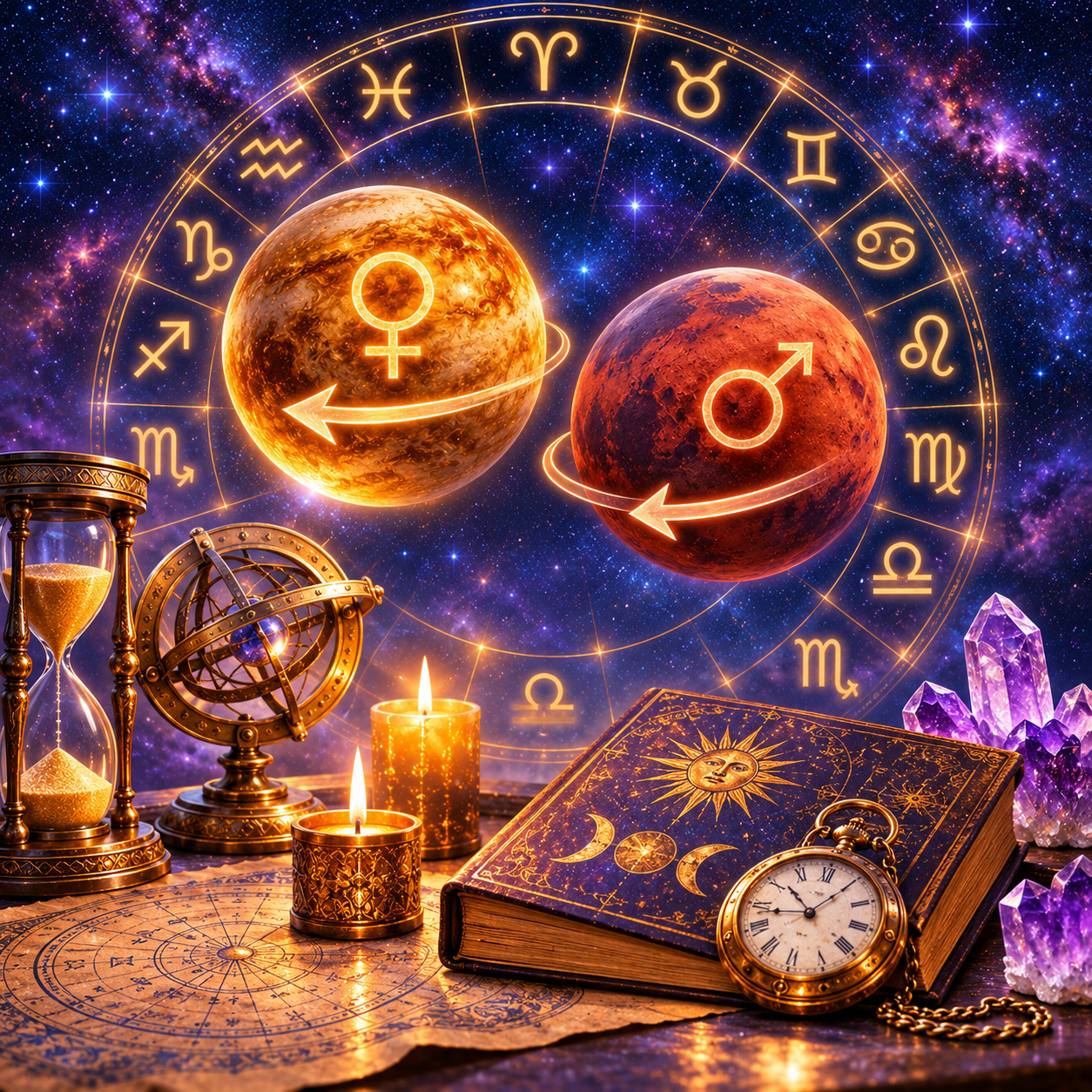
Retrograde Mercury is often heard, but both Venus and Mars have periods when they seem to be going back into the sky. They are rarer and longer, and astrological tradition gives them different meanings: Venus retrograde is associated with relationships and values, Mars retrograde with energy and action. The astronomical mechanism is the same as in Mercury, but the duration and frequency differ greatly.
The guide explains why these demographics occur, how long they last, how they look in the sky, what astrologers say about them, and how you can use them as a reflection opportunity. For the general principle of retrograde movement, see first article on Retrograde Mercury.
Why do planets seem to be going back
Earth and other planets orbit the Sun at different speeds. When the Earth “surpasses” an outer planet (like Mars) or is overtaken by an inner planet (like Venus), the planet appears to be making a loop in the sky, moving for a few weeks in reverse of the stars. It’s an illusion of perspective; the planet doesn’t change meaning in orbit.
Venus retrograde
Venus lies between Earth and the Sun. When the Earth surpasses it in its orbit, Venus seems to be going back. This happens approximately every 584 days, i.e. every 19 months, and the demarcation lasts about 40- 43 days. During the demarcation, Venus is close to the lower conjunction with the Sun, so you can see very little in the sky, as an “evening star” that disappears and then reappears as a “morning star.” Venus’ latest demarcation took place in the summer of 2026, and the previous one in marti- April 2025.
Retrograde Mars
Mars orbits beyond the Earth, and demarcation occurs around the opposition, which is when the Earth passes between Mars and the Sun. The period between two oppositions is about 780 days, which is about 26 months, and the demarcation lasts about 72 days, more than two months. Near the opposition, Mars is closest to Earth and brightest, which makes it easy to see.
| Venus | Mars | |
|---|---|---|
| Rear-off interval | (19 months) | (26 months) |
| Duration of demarcation | For the purposes of this Regulation, the following definitions apply: | For the Commission |
| As you can see in the sky | It fades near the Sun | maximum shine towards the middle of the period |
| Astrological theme | relations, values, aesthetics, money | energy, action, desire, conflict |
What does astrology say about retrograde Venus
Venus symbolizes affection, values, aesthetics and personal resources. In retrograde, tradition reads it as an invitation to re-evaluation: what I value, what relationships feed me, what expenses make sense. The usual advice is to avoid impulsive decisions about the appearance or the money and pay attention to “returns” in the past, such as former partners or old themes in relationships. It’s a symbolic frame.
What does astrology say about retrograde Mars
Mars symbolizes energy, action, ambition and anger. In retrograde, the tradition says that energy turns inward: plans progress harder, frustrations appear easier, and projects may require revision. The usual advice is not to start new fights, review strategies and take care of the body. Again, they’re symbols, not forecasts.
Retrograde phases
As in Mercury, astrologers describe a five-step model: the shadow before, the retrograde stationary, the retrograde period, the direct stationary and the shadow after. Stationaries are the moments when the planet seems to be standing still in the sky; in astrology they are considered the most intense. Accurate details vary between sources and data are found in ephemeral.
What research says
There is no evidence that planet demographics influence human relationships, money or energy. Studies on the “retrograde Mercury effect ‘found no statistical differences in errors or accidents. The psychological explanation is the confirmation bass: when we know that one planet is retrograde, we remember more easily the events that fit and forget the others.
How you use a relegation as an opportunity for reflection
- Venus: make an inventory of things and relationships you care about. What would you like to keep?
- Mars: revises a strategy. What projects deserve energy and which projects do not?
- Both: note what you observe without automatically assigning everything to the planet.
- Do not postpone urgent things just because the planet is retrograde.
Retrogradation in the birth map
If you have Venus or Mars retrograde in your native map, astrologers write it down with the letter R Traditional interpretation states that the planet expresses itself as “more discreet or reflexive.” Statistically, Venus is retrograde in about 7% of people, as the demarcation takes little to 584 days, and Mars at about 9%. It is therefore a relatively rare feature, but not exceptional. For what the planets represent, see planet guide and for the map as a whole map guide.
How do you observe a demarcation yourself?
Mars is the easiest to track: in a few weeks his position on the stars around him changes visibly, slows down, stops and then returns. If you write down his position every few days on a map of the sky, you’ll draw a loop. It’s a classic exercise that shows why ancient astronomers had to invent complicated patterns (epicycls) before the heliocentric model explained everything simple.
Epicycls: how ancient astronomers explained the retrograde
For the Greeks, the Earth was at the center of the universe, and demographing seemed a problem: why would a planet go back? Ptolemy’s solution, in the third century AD, was a system of epicycls: the planet moves on a small circle, the center of which moves on a large circle. The combination produces loops that mimic the observed retrograde. The model has functioned with sufficient precision for 1,400 years. When Copernicus put the Sun in the center, demarcation became a natural effect of the Earth’s movement without additional circles. It is one of the most beautiful historical demonstrations of how a simpler model can replace a complicated one.
How close and how bright
In opposition, Mars is at a distance from Earth that varies, depending on opportunity, between about 56 and 101 million kilometers. Close oppositions are rare (at 15-17 years) and make Mars a very bright object, visible all night. Venus is the brightest planet in our sky, and it reaches maximum brightness weeks before and after the lower conjunction; in full demarcation, however, it is too close to the Sun to be observed. To know when you can see planets, use an astronomy application or an observation calendar.
Common
- Confusion of retrograde with a real change of direction. It’s an illusion of perspective.
- Using retrograde as an excuse. If you delay an important decision, you should do it for real reasons.
- The assumption that all downgrades are the same. They have different durations and frequencies.
- Fear of retrograde. In tradition it is a moment of reflection, not of danger.
If you want to keep track, note in a notebook the beginning and end dates of the demographics of Venus and Mars from the astronomical calendar and compare them with your own observations after a year or two: you will see how often the impressions match the real data.
Frequently asked questions
How long is Venus retrograde?
About 40-43 days, about 19 months.
How long does retrograde Mars last?
Approximately 72 days, approximately 26 months.
What if I start a relationship this time of year?
There is no evidence that downgrading affects relationships; every relationship depends on people, not planets.
Why doesn’t Venus look retrograde?
Because then it’s very close to the Sun and it almost doesn’t show.
Astrology is a symbolic system, not a science. The astronomical explanation of retrograde is verifiable.