
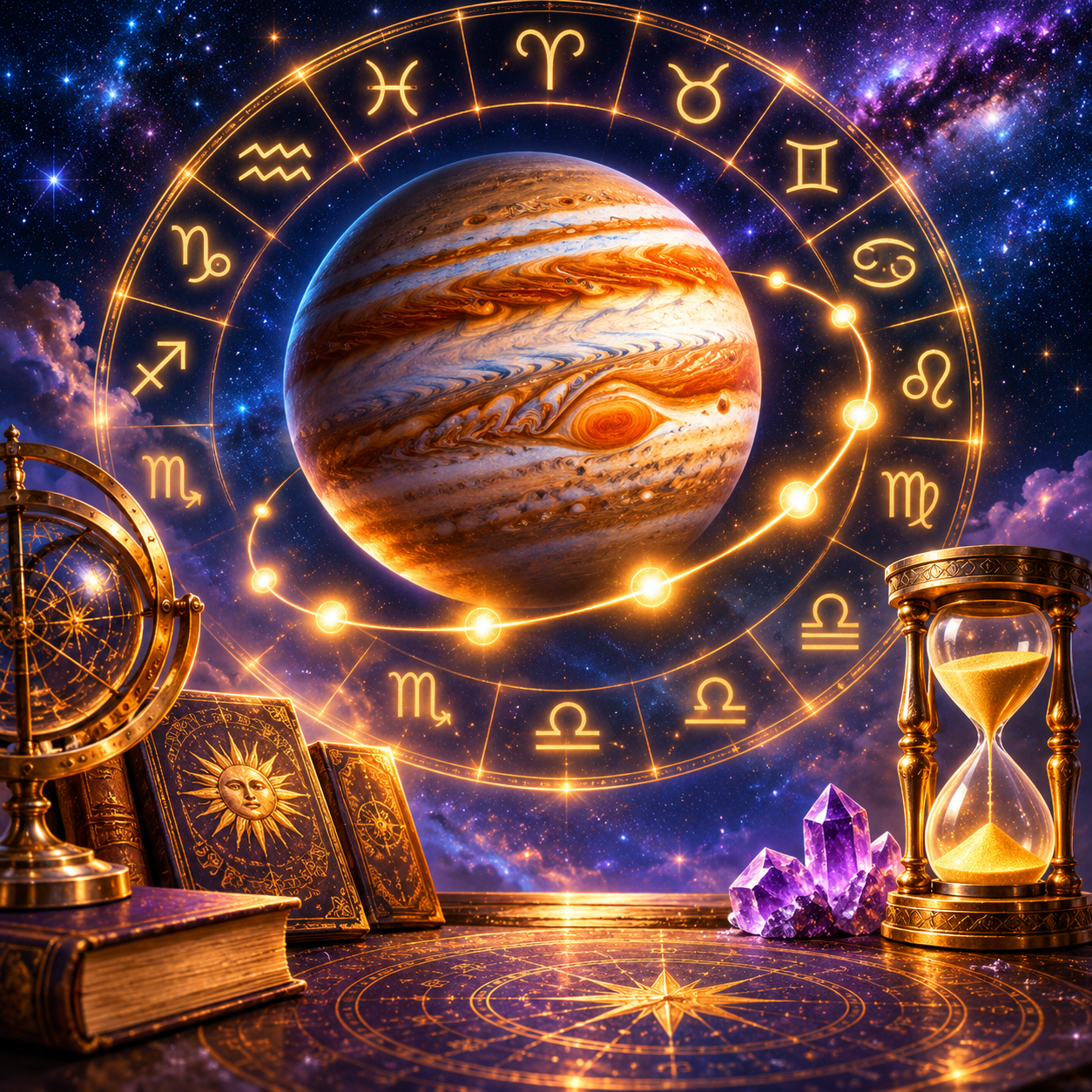
Jupiter is the largest planet in the solar system and, in astrology, the planet of expansion, optimism and learning. His cycle lasts about 12 years, which has made him, throughout history, a kind of “clock” of the stages of life: at 12, 24, 36, 48, 60 years old, Jupiter returns close to his position at birth.
The guide explains what Jupiter is astronomically, how long it stands in a sign, what “return of Jupiter” means, how astrologers interpret it and what you can see in the sky. Astronomical facts are accurate, and interpretations are symbolic.
Jupiter in figures
| Feature | Abstract value |
|---|---|
| Mass | about 318 times the mass of the Earth |
| Diameter | about 11 times that of the Earth |
| Orbital period | 11.86 years |
| Rotation around the axis | approximately 9 hours and 56 minutes |
| Time in a zodiac sign | about 1 year |
| Opposition interval | approximately 399 days |
| Annual Retrogradation | approximately 4 months |
Jupiter contains more than twice the mass of all other planets combined. It has over 90 known months; the four major Io, Europe, Ganymede and Callisto were discovered by Galileo Galilei in 1610. The Great Red Spot, a visible storm for centuries, is bigger than Earth.
Jupiter in astrology
In astrological tradition, Jupiter symbolizes expansion, generosity, optimism, faith, learning and travel. The name comes from the Roman god of heaven. It was called, in ancient astrology, “the great beneficial,” unlike Saturn, “the great evil.” Modern astrologists avoid these labels, noting that expansion can be excessive (waste, lack of measure) and limits may be necessary. About the other planets read Planet Guide.
Jupiter in signs
Jupiter stays about a year in each sign, so all people born in one year generally have Jupiter in the same or two neighboring signs. In interpretation, the sign says “how” the expansion is expressed: in Aries through initiative, in Taurus through accumulation and stability, in Gemini through curiosity and learning, in Cancer through care and family, in Leo through generosity and creativity, in Virgo through utility and refinement, in Libra through relationships and balance, in Scorpio through depth, in Sagittarius through exploration and faith (sign of “domicile”), in Capricorn through structured ambition, in Aquarius through collective ideals, in Pisces through compassion and imagination.
The return of Jupiter
Jupiter returns to its native map at its original position at approximately 11.86 years. The first return takes place at 11-12 years, the second at 23-24, the third at 35-36, the fourth at 47-48, the fifth at 59-60 years and so on. Due to the retrograde, the planet can go through two or three times the same degree in a year.
| Return | Approximately age |
|---|---|
| First | 11- 12 years |
| Second | 23-24 years |
| Third | 35-36 years |
| Fourth | 47-48 years |
| Fifth | 59- 60 years |
| Six a | 71-72 years |
Astrologists read these moments as opening opportunities: learning opportunities, changes in direction, periods of growth or optimism. Compare with Saturn’s return from this guide, interpreted as a balance sheet moment; the two planets symbolically form the “expansion-structure” pair.
How do you know your moments
- Find Jupiter’s position in your native map (mark and rank).
- Add 11.86 years to the date of birth for the first comeback, then 11.86 years for the second and so on.
- Check in an ephemeral exact date when Jupiter passes that degree.
Example: If you were born on 15 July 2000, your first approximate return is around May 2012 (15 July 2000 + 11.86 years). The second is around April 2024 (+ 23.72 years of age), the third around February 2036. The exact data depends on Jupiter’s position and demographics, so these are estimates.
Jupiter and his opposition
Another important moment is Jupiter’s opposition to his native position, approximately 6 years, 18 years, 30 years and so on (half a cycle). Tradition reads it as a “balancing” moment between expansion and reality. Note that half-cycles, around 18 years of age, coincide approximately with the beginning of adult life.
Jupiter and luck: what science says
They often say “Jupiter brings good luck.” There is no evidence that his position influences anyone’s chances. However, psychology shows that optimism and openness to opportunities really increase the chances of taking advantage of opportunities. Jupiter is, in this respect, a good metaphor for “how about being more open this year?,” not a preacher. About how to distinguish interpretation from facts, see guide on astrology, astronomy and science.
How do you see Jupiter in the sky
Jupiter is usually the second brightest planet after Venus, easily recognizable, because it does not sparkle and has a firm yellow-white light. With a stable binoculars you can see the four great moons in the form of points aligned near the disk, and from one night to the next their position changes. These are the observations by which Galileo showed in 1610 that not all bodies revolve around the Earth. With a small telescope, cloud bands appear.
Reflection exercises for a return of Jupiter
- What have I learned in the last 12 years and what do I want to learn in the next 12 years?
- Where did I most extend the horizon and where did I get stuck?
- What reasonable risk would I take if I had more confidence?
- What do I want to offer others from what we’ve received?
Why Jupiter was “king of the gods”
In Roman mythology, Jupiter was the supreme god of heaven and lightning, equivalent to the Greek Zeus. His name was probably given to his planet because of its powerful brilliance and size: of the planets visible to the naked eye, he is the largest and, apart from Venus, the brightest. Thursday (“Jovis dies” in Latin) is his name, which is why, in Latin languages, Thursday is called jeudi, giovedý or jueves. Tradition attached to it all the themes of royalty: generosity, justice, wisdom and abundance.
Jupiter and Saturn: the most discussed pair
For ancient astrologers, the two slower planets were the pillars of “long time”: Jupiter gives direction and confidence, Saturn limits and structure. Their meetings are called great conjunctions (see guide to great conjunctions]) and occur approximately every 20 years. For a man, the same two planets form a kind of rhythm of life: periods of expansion followed by periods of consolidation, a pattern that psychologists describe in other words.
If you want to make Jupiter a pleasant habit, choose a simple binoculars and note in a notebook, for a month, the position of his moons every night serene. You’ll see how the configuration changes from day to day and you’ll actually understand what Galileo saw.
Remember what?
- Jupiter returns to your home map every 12 years.
- Traditional interpretation is “expansion,” but keywords differ between sources.
- There is no scientific evidence that Jupiter brings luck; the effects are psychological and cultural.
- You can see the planet easily with binoculars: it’s a simple, cost-free exercise.
Frequently asked questions
How long does Jupiter stay in a sign?
About a year, with variations due to retrograde.
Is Jupiter the planet of fortune?
In tradition yes, as a symbol of expansion; scientifically there is no evidence.
When’s my first comeback?
About 12 years after birth.
Can I see Jupiter without a telescope?
Yes, it’s visible to the naked eye when it’s above the horizon; for its moons you need binoculars.
Astrology is a symbolic system, not a science. Astronomical data is verifiable.