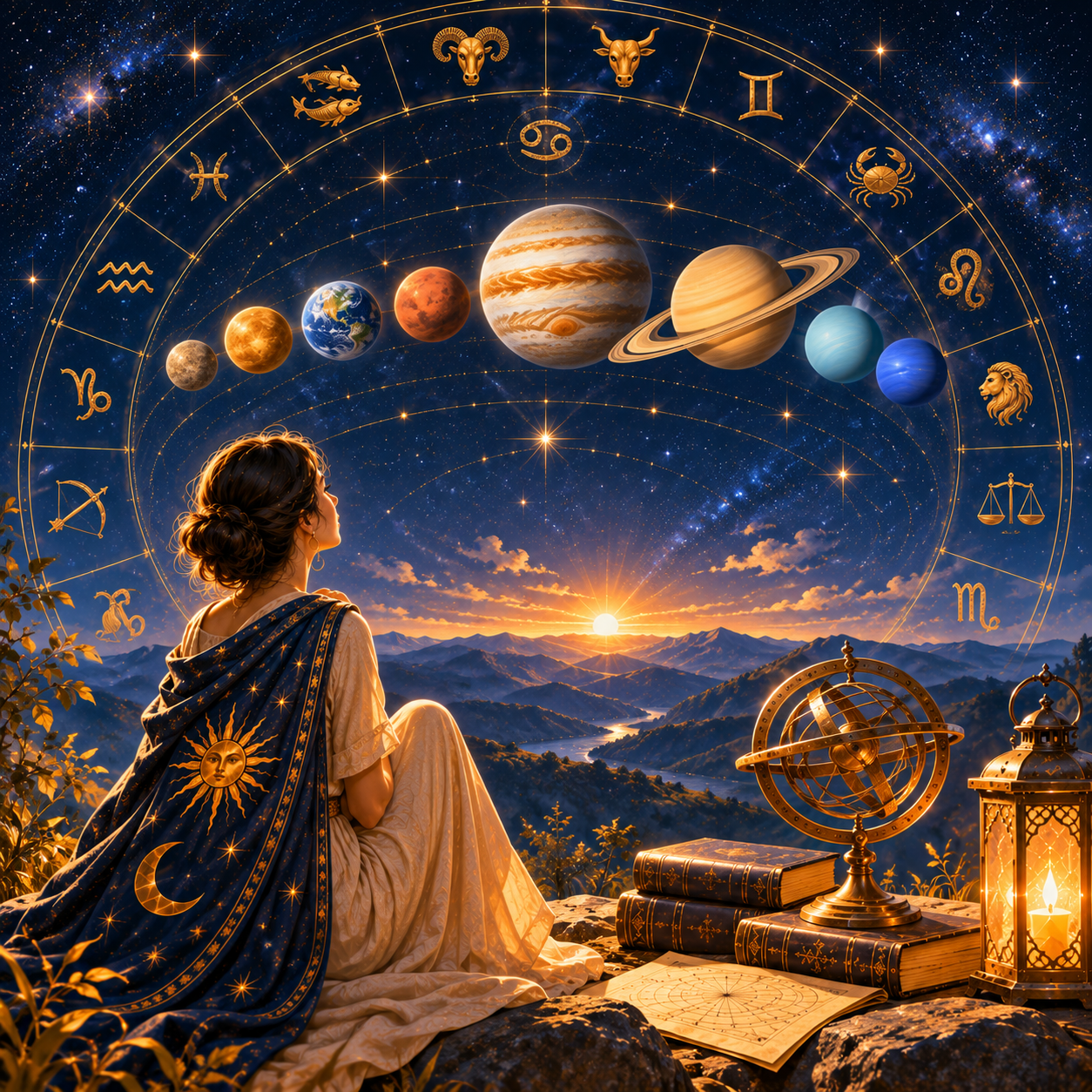
When an astrologer reads a native map, planets are “actors”: each symbolically represents a psychological function or an area of life. The signs describe his style, and the houses say where. Without planets, the map would be an empty circle.
In the article you can find the ten bodies used in modern astrology, which symbolize each, while they stand in one sign and why some are considered “personal” and others “generational.” We use the term “planet” in an astrological sense: Sun and Moon are included, although astronomical are not planets.
How do planets divide?
| Group | Bodies | Rhythm |
|---|---|---|
| Lighting | Sun, moon | Quick: Sun one year, Moon ~ 27 days on the Zodiac |
| Personal plants | Mercury, Venus, Mars | from few weeks to a few months in a sign |
| Social Planets | Jupiter, Saturn | about 1 year and 2.5 years respectively in a sign |
| Pomersonal plants | Uranus, Neptune, Platoon | 7, 14 and 12-31 years in a sign |
The duration of a past by a sign is approximate. Platoon, for example, has a very eccentric orbit: in Scorpio he spent about 12 years, in Capricorn about 16, and in Taurus about 30.
The ten bodies, in brief
Sun
Identity, will, core of personality. The sun makes a detour of the zodiac within a year, so it stays about a month in a sign. The sun’s sign is your usual sign.
Moon
Emotions, needs, instincts, memory. The month travels the zodiac in approximately 27.3 days and stays about two and a half days in a sign. About her cycle see also article about the three signs.
Mercury
Thinking, communication, learning, language. It doesn’t depart from the Sun by more than about 28 °, so it’s in the same sign as the Sun or in the neighbor. His retrograde movement is explained in this guide.
Venus
Affection, values, aesthetics, relationships. Venus is always at most 48 ° from the Sun, so in the same sign or at most two signs of it.
Mars
Action, energy, desire, courage, conflict. Mars spends about two months in a sign, and a complete cycle of the zodiac takes about two years.
Jupiter
Enlargement, optimism, learning, symbolic luck. Jupiter stays about a year in a sign and takes a tour of the zodiac in about 12 years.
Saturn
Structure, boundaries, responsibility, time. Saturn stays about two and a half years in a sign and returns to the position in your home map at about 29.5 years.
Uranus
Change, originality, tear, technology. Discovered in 1781, stays around seven years in a sign and takes a tour in about 84 years.
Neptune
Imagination, dream, ideal, confusion. Discovered in 1846, he travels the zodiac in about 165 years.
Platoon
Transformation, power, depth. Discovered in 1930, it was reclassified in 2006 by the International Astronomical Union as a dwarf planet, but astrologers still use it. His cycle is about 248 years old.
Why the Sun and Moon are not planets, but they count
Astronomical, the Sun is a star and Moon is a satellite. Traditional astrology has called “planets” all bodies that seem to move in the sky towards fixed stars, which is why it includes both lights. The word “planet” comes from the Greek for “wanderer.”
Traditional and modern planets
The ancient astrology used only the seven bodies visible to the naked eye: Sun, Moon, Mercury, Venus, Mars, Jupiter, Saturn. Uranus, Neptune and Platoon were added after their discovery. Some traditional astrologists continue to ignore them; the modern ones include them. Each sign also has a “leader,” i.e. the planet with which it is associated by tradition: Aries-Mars, Taurus-Venus, Gemini-Mercury, Cancer-Moon, Leo-Sun, Virgo-Mercury, Libra-Venus, Scorpio-Mars (traditional) or Platoon (modern), Sagittarius-Jupiter, Capricorn-Saturn, Aquarius-Saturn (traditional) or Uranus (modern), Pisces-Jupiter (traditional) or Neptune (modern).
How do you use planets to read the map?
- Planet says “what ‘: symbolic function.
- The mark says’ how ‘: style.
- House says “where ‘: the field of life (see astrological houses]).
- Issues say “with what connection ‘(see aspects).
For example, “Mars in Taurus in the Sixth House” is symbolically read: energy (Mars), manifested with patience and stubbornness (Taurus), in the labour and routine area (Sixth House). Like any astrological formula, it’s a reflection vocabulary.
What astronomy says about planets
Planets are physical bodies, with measurable masses and distances. The gravitational influence of planets on a man at birth is negligible, smaller than that of the obstetrician in the chamber. Scientific research has shown no link between the positions of the planets and the traits of the person. That’s why we treat astrological planets as symbols, not forces.
Planets and Days of the Week
Tradition linked the seven classical bodies during the days of the week, and the tracks are seen in Romanian: Monday (Moon), Tuesday (Mars), Wednesday (Mercury), Thursday (Jupiter), Friday (Venus). Saturday is linked to Saturn and Sunday to the Sun, in English languages (Saturday, Sunday). It’s a beautiful example of how astrology has left traces in everyday culture, even in those who don’t follow it.
How new planets were discovered
Uranus was discovered by William Herschel in 1781, which was a surprise: for millennia Saturn had been believed to mark the edge of the solar system. Neptune was found in 1846, after mathematicians predicted his position from the disturbances of Uranus’ orbit. Platoon was discovered by Clyde Tombaugh in 1930. After each discovery, astrologers added the new body to the system and assigned it symbolic themes suitable for the age: Uranus with revolutions and innovation, Neptune with ideals and illusions, Platoon with profound transformations.
Personal planets in your map, briefly
For a quick portrait, look first at the Sun, Moon, Mercury, Venus and Mars. The sun tells you what you want to express, Moon what you need, Mercury how you think and talk, Venus how you value and how you love, and Mars how you act. The slow planets (Jupiter to Platoon) are the same for everyone in your generation or for several consecutive years, so it matters mostly through the house where they fall and through the aspects with the personal planets.
Fast and slow planets: why difference matters
If you were born on the same day as a colleague, you have the Sun in the same sign and almost certainly Mercury, Venus and Mars in close positions. If you were born in the same year, you probably have Jupiter and Saturn in the same signs. The slower the planet is, the more people have it in the same sign. That’s why astrologists say fast planets differentiate you as an individual, and slow ones place you in a generation. A personal map is born from the combination of the two groups and, above all, the ascendant, which changes every two hours.
This reasoning also explains why reading a single planet, outside the Sun, says little: it matters the entire picture, meaning the planet, sign, house and aspects. If you’re at the beginning, summarize your map to a simple phrase for each personal planet and then add the details gradually.
Frequently asked questions
How many planets does a map have?
The ten bodies above, plus often monthly nodes and Chiron. The number varies according to the programme.
What does “dominant planet” mean?
The planet that appears most emphatically in the map, by position, aspects or by leading the ascendant. It’s a concept of interpretation.
Why is Platoon no longer a planet?
Astronomers reclassified it as a dwarf planet in 2006; astrologers keep it because the symbol has consolidated.
Can I find out for myself the positions of the planets?
Yeah, with a birth map program or an ephemeral. For the ascendant, start with the computer on the site.
Astrology is a symbolic system, not a science. The astronomical data in the article is verifiable.