The horoscope you’re reading in your phone today has a history of over two thousand years. It began from astronomers’ observations in Mesopotamia, was transformed into a system by the Greeks, passed through the Arab world and through medieval Europe, lost science status in the 17th century and returned as entertainment in modern media. His history says a lot about what astrology looks like today.
In this article you follow the main stages: Babylon, Hellenistic Egypt, Greece and Rome, the Islamic world, medieval Europe and Renaissance, decline as science, the emergence of newspaper horoscope. Data are those accepted by historians, with the mention that some beginnings are unclear.
Mesopotamia: the sky as the language of the gods
The inhabitants of Mesopotamia observed the systematic sky at the end of the third millennium BC The tablets known as Enuma Anu Enlil gather thousands of assumptions about heavenly events and what they might announce for the king and the country. Another text, MUL.APIN, from around 1000 BC, lists constellations and stars that rise and set during the year. Astrology at the time was “state astrology”: it did not concern ordinary people, but kings and empires.
Zodiac of 12 equal signs
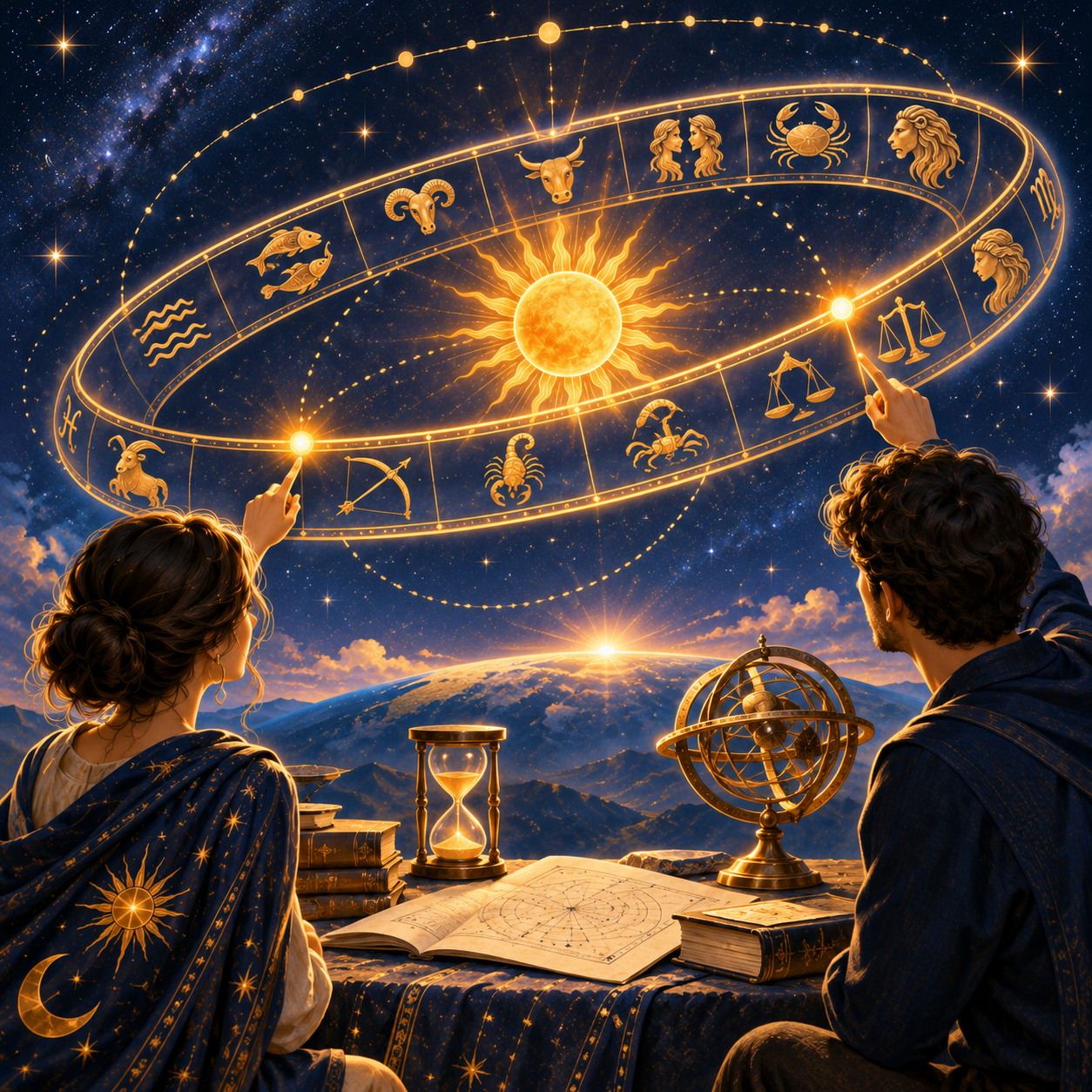
Around the 10th century BC, Babylonian astronomers divided the ecliptic into 12 sectors of 30 ° each bearing the name of a nearby constellation. The advantage was practical: a uniform system for measuring the positions of planets. The oldest preserved native horoscopes are Babylonian, from approximately 410 BC, and indicate the positions of the planets at birth without detailed interpretations.
Hellenic Egypt and Greece: Modern astrology is born
After the conquests of Alexander the Great, Babylonian ideas mixed with Greek philosophy and Egyptian tradition. This is how the Hellenistic astrology (from the III centuries BC) emerged, which introduced the ascendant, houses, aspects and meanings of the planets, i.e. the exact structure known today (see calculation of the ascendant and houses). Greek astronomer Hiparh discovered the precession of equinocies (see Tropical and Steel Zodiac).
In the third century AD, Claudius Ptolemy wrote Almagesta (astronomy) and Tetrabiblos (astrology), two works that influenced Western thinking for almost 1,500 years. Other important authors are Dorius and Vettius Valens.
The Islamic world and the Middle Ages
Since the 16th and 9th centuries, scholars from the Islamic world have translated and developed Greek and Indian texts. Abu Ma’shar al-Balkhi (9th century) and al-Biruni (X- XI centuries) wrote influential works of astrology and astronomy. Through translations from Arabic to Latin, from the 18th-13th centuries, the tradition reached Europe, where it was taught in universities, often alongside medicine and astronomy.
Renaissance and Scientific Revolution
In the Renaissance, astrology was spread in the courts: Marseilio Ficino wrote about the influence of planets, and many rulers had their own astrologers. Johannes Kepler, the discoverer of the laws of the planetary movement, drew horoscopes for money himself, though he was skeptical of many practices of the age. In the XVIL-XVIII centuries, with Copernicus’s heliocentric model, Newton’s law of gravity and his new way of doing science, astrology lost the support of universities. Astronomy and astrology broke up permanently.
Modern resurrection
In the XIX-XX centuries, astrology returned to Europe and America through occultism, theosophy and later psychology: Alan Leo popularized astrology in England, and Dane Rudhyar linked her to deep psychology. The newspaper horoscope appeared in 1930, when astrologer R.H. Naylor published in a British newspaper an article about the birth of Princess Margaret, with predictions based on the sun sign; readers demanded more and the format spread quickly. Today, horoscopes are among the most widely read items in the press and the Internet.
Chronology in brief
| Period | Event |
|---|---|
| approx. 1000 B.C. | MUL.APIN lists mesopotamian constellations |
| approx. 500 BC | Zodiac of 12 equal signs in Babylon |
| approx. 410 BC | Oldest preserved native horoscope |
| 2nd century BC | Hiparh discovers precedent |
| 2nd century AD | Ptolemy writes Tetrabiblos |
| AD IX | Abu Ma’shar in the Islamic world |
| 17th century | Astrology comes out of universities |
| 1930 | First newspaper horoscope on zodiac signs |
Astrology in Romans
In Rome, astrology was fashionable and suspicious at the same time. The emperors used it, but they also forbade it when they feared that predictions of their death could fuel plotting: astrologers were expelled several times from the city. The Latin texts preserved, such as Manilius’ Astronomical poem (1st century AD), show how to mix poetry with the sciences of heaven. Among the Romans comes the fashion to search for the “lucky day” for important decisions, usually which reach, adapted, up to today’s popular calendars.
India and China: parallel traditions
In India, the Vedic astrology (Jyotish) developed in parallel, with Hellenistic influences and a tradition of its own based on the steel zodiac (see this article). In China, the system was built around the lunisolar calendar, the 12 animals and the elements (see the Chinese zodiac). The three traditions have common points, but also great differences: they are different “languages” to talk about time and sky.
How people read horoscopes in the past
For a reader in the Middle Ages, a horoscope was an expensive document, commissioned by a specialist, often related to medicine: each body organ was thought to correspond to a sign, and the “right day” for an intervention was chosen after the moon. Today, a horoscope costs as much as a click and is often written to millions of people simultaneously. The change of scale explains why the modern horoscope is so general: a text for all those born in a month cannot be personal.
What’s left of history
If you look at a home map today, you see almost the same vocabulary used in Alexandria two thousand years ago: 12 signs, classic planets, ascending, houses, aspects. For this reason, many regard it as a cultural heritage, as well as mythology. But the fact that something is old doesn’t make it true: just as old are many disproved medical ideas. The distinction between cultural value and scientific value is the healthiest approach.
An important detail: throughout history, the same people were often both astronomers and astrologers. Ptolemy, Kepler and many others would not have understood the question “is astronomy or astrology?,” because both were parts of the same observation of the sky. The breakup came late and was largely the result of the requirement for experimental verification.
Words that are left of astrology
Our language preserves traces: “disaster” (from “bad star”), “influence” (from “flowing from the stars”), “lunatic” (influenced by the Moon), “jovial” (from Jupiter), “satnin,” “mercurial,” “martial.” The days of the week are named after the classical stars: Monday (Moon), Tuesday (Mars), Wednesday (Mercury), Thursday (Jupiter), Friday (Venus). Words show us how deep astrology has penetrated culture.
Knowledge of history helps you read horoscope without naivety and disdain: it is a long tradition with roots in real observations of heaven, but its interpretations have been built by people over time and can be regarded as such.
Frequently asked questions
Who invented the zodiac?
The division into 12 equal sectors appeared in Babylonian astronomers, around the 5th century BC The names of the signs come from different constellations and mythologies.
When did the newspaper horoscope turn up?
In 1930, in a British newspaper, with predictions on the solar sign.
Why isn’t astrology in universities any more?
Because with modern science, her predictions could not be confirmed by testing, and astronomy became a self-standing science.
Was the Zodiac always the one in the press today?
The basic structure is old, but interpretations have changed a lot; modern psychological astrology, for example, is a 20th century development.
Historical information is presented on the basis of sources accepted by historians; astrology is not a science.