
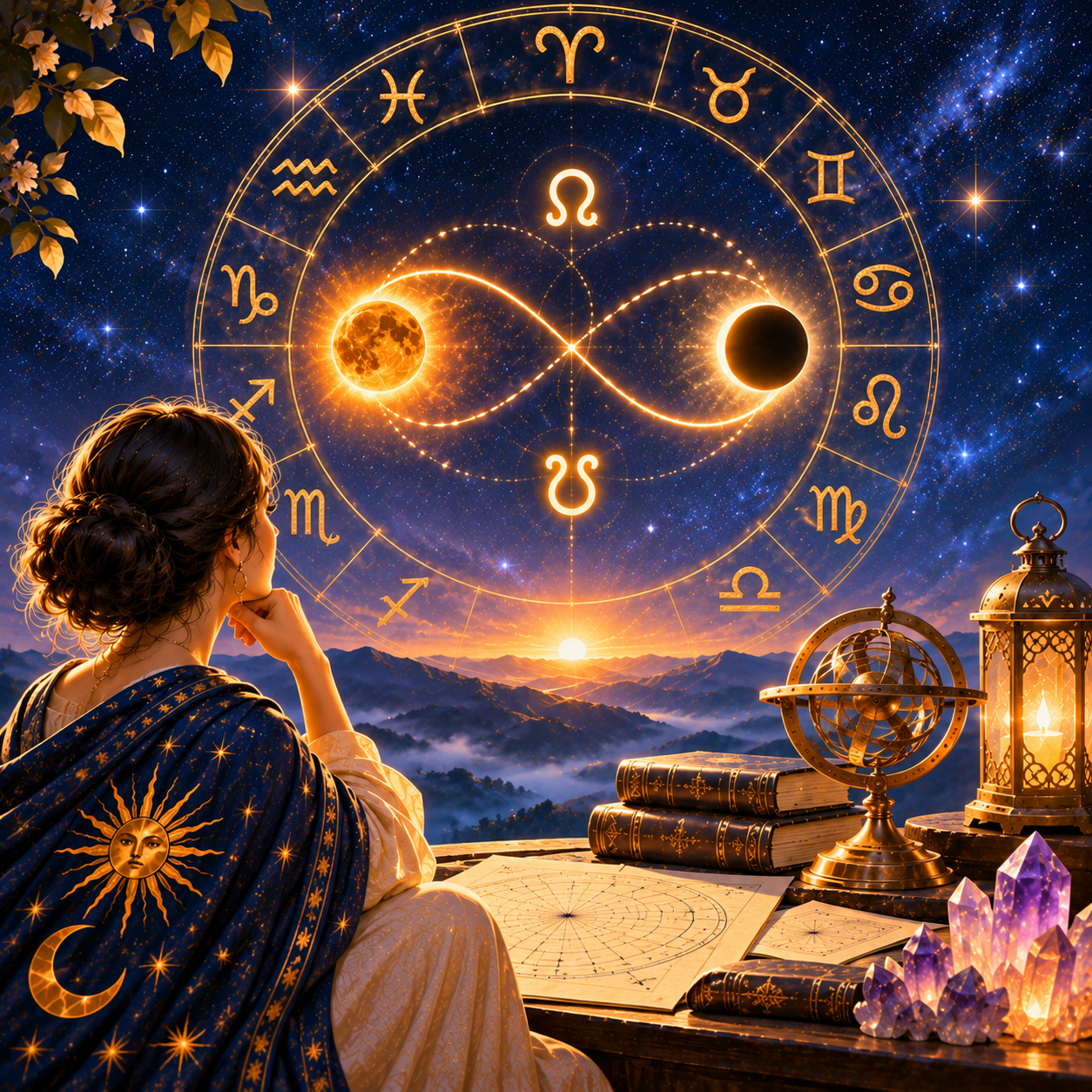
Four moments of the year divide the zodiac into equal quarters: the two equinox and the two solstice. In astronomy, they mark the beginning of seasons. In Western astrology, they coincide with the entrance of the Sun to the Aries, Cancer, Libra and Capricorn, i.e. the four cardinal signs. Their understanding explains, one by one, why there are seasons, why the 21st of March is not fixed and why the tropical zodiac is linked to Earth, not to the stars.
The guide explains why there are seasons, what are equinotics and solstities, how they relate to the zodiac, what happens to days in the northern hemisphere and what means “cardinal signs.” The data is astronomical and verifiable.
Why are there seasons
The Earth rotates its axis inclined approximately 23.44 ° to the plane of orbit around the Sun. When the northern hemisphere is tilted towards the Sun, it receives more direct light and the days are longer: it is summer. When it’s tilted to the opposite side, it’s winter. The distance between Earth and the Sun is not the cause: Earth is closer to the Sun in January, when the northern hemisphere is winter.
Four moments of the year
| Moment | Abstract date | Position of the Sun | What happens in the northern hemisphere |
|---|---|---|---|
| Spring equinox | 20–21 March | 0 ° Aries | Day and night almost equal; spring begins |
| Summer solstice | 20–21 June | 0 ° Cancer | Longest day; summer begins |
| Autumn equinox | 22–23 September | 0 ° Libra | Day and night almost equal; autumn begins |
| Winter solstice | 21–22 December | 0 ° Capricorn | Shortest day; winter begins |
The data vary by one day by year and by time zone for reasons explained in the article on the data of zodiac signs.
What is equinox and solstice?
Echinoctium (Latin, “equal night”) is the moment when the Sun crosses the heavenly equator. At that time, day and night have about the same duration throughout the globe. Solstice (from Latin, “Sun sitting”) is the moment when the Sun reaches the largest distance from the equator, north or south. Around it, the height of the sun at noon seems not to change for a few days, hence the name.
How to tie to zodiac
The tropical zodiac, the one used in Western astrology, is defined precisely on these points: spring equinox is 0 ° Aries, summer solstice 0 ° Cancer, autumn equinox 0 ° Libra, and winter solstice 0 ° Capricorn. Therefore, the tropical zodiac is linked to the seasons, not to the constellations in the background. Due to the precedence of the equinox, the constellations moved from these points, which explains the difference from the steel system described in this guide.
Cardinals, fixed and mutable
The four signs in which a season begins (Aries, Cancer, Libra, Capricorn) are called cardinals. In tradition, each season has three signs: one that begins (cardinal), one in the middle (fixed) and one that makes the transition to the next (mutable). For example, spring: Aries (cardinal), Taurus (fixed), Gemini (mutable). About this division by modalities, see also our article on astrological modalities.
Long and short days: what happens in Romania
At Romania’s latitude (about 44 ° -48 ° north), the day from the summer solstice lasts about 15.5- 16 hours, while the day from the winter solstice lasts about 8- 8.5 hours. At equinox, the day has about 12 hours. The rhythm changes faster around the equinox, when the duration of the day increases or decreases by about 2- 3 minutes a day, and slower around the solstice, when it changes only by a few seconds a day.
Solstice and equinox in crops
These moments were celebrated by peoples all over the globe: Stonehenge is aligned with the sun’s sunrise from the summer solstice and the sunset from the winter solstice; the Chichén Itzá pyramid in Mexico has a shadow game of equinox. In the Romanian tradition, the summer solstice is linked to Sânzian (June 24th), and the winter one to Christmas holidays, but the calendar data moved over time to the actual astronomical moments, due to calendar reforms.
Why does astrological matter
For astrologers, the entrance of the Sun into one of the cardinal signs is a “ingress,” a moment at which a map is calculated, used for the quarter perspective. It’s an interpretation convention. Astronomical, instead, these moments are accurate, calculated decades before.
How do you calculate your position of the Sun
If you want to understand how it is calculated, take the number of days from the spring equinox and multiply it by approximately 0,9856 °, the average daily movement of the Sun. Example: on 1 May, that is, 42 days after 20 March, the Sun is approximately 42 × 0,9856, which is approximately 11 ° Taurus. It’s an approximation: The sun moves slightly faster in winter and slower in summer due to Earth’s elliptical orbit, so the error can reach about 2 °.
What happens every season, astronomical
Between the spring equinox and the summer solstice, the sun rises higher and higher in the sky at noon and the days grow. After the summer solstice, the days begin to fall slowly, reaching again 12 hours at the autumn equinox. After the winter solstice, the cycle reverses. The fact that the four points pass slightly uneven intervals (spring and summer are longer than autumn and winter in the northern hemisphere) is the consequence of Earth’s elliptical orbit: in winter, when the Earth is closer to the Sun, it moves faster in orbit.
| Anotime (Northern hemisphere) | Summary duration |
|---|---|
| Spring | 92.8 days |
| Summer | 93.6 days |
| Autumn | 89.8 days |
| Winter | 89.0 days |
What does it mean for the horoscope
The horoscopes of the seasons (e.g. the “spring horoscope”) rely on the ingress of the sun in cardinal signs. An astrologer would calculate the sky map for the exact moment of the equinox or solstice, in a chosen city, and read it as a theme of the quarter. For the regular reader, it is worth noting that these are conventions: there is no evidence that an ingress changes events, but there are real, easy-to-check moments where the season changes.
If you want to observe these moments yourself, choose a place with a free horizon and note, over a year, where the sun rises: the equinox rises almost to the east, the summer moves to the north-east, and the winter to the south-east. The displacement is visible to the naked eye and helps you understand the cycle better than any table.
Common
- The belief that summer is due to the proximity to the Sun. The cause is the inclination of the axis.
- The assumption that the equinox is always on March 21. It may be 19, 20 or 21 depending on the year and time zone.
- The confusion between the meteorological and astronomical seasons. Meteorologists reckon the spring of 1 March, the astronomers of equinox.
- Mixing hemispheres. In the south, the solstice in June is the winter solstice.
One last useful detail: if you keep a simple astronomical journal, note every month the time of sunrise and sunset in your city, and after a year you will have your own curve of the day, with the four turning points clearly visible.
Frequently asked questions
Why is equinox sometimes on March 20th and sometimes 21st?
Because the tropical year does not have a full number of days, and the exact moment varies by up to one day, plus the time difference.
Is it true that days are equal to equinox?
Approximately. Because of the atmospheric refraction and the fact that the Sun is not a point, real equality takes place days before the spring equinox and after the autumn equinox.
When is “New Year Astrological”?
Many astrologers consider the spring equinox when the Sun enters the Aries, the beginning of the zodiac cycle.
Are they the same in the southern hemisphere?
Moments are the same, but seasons are reversed.
The astronomical data in the article is verifiable; astrological interpretations are symbolic.