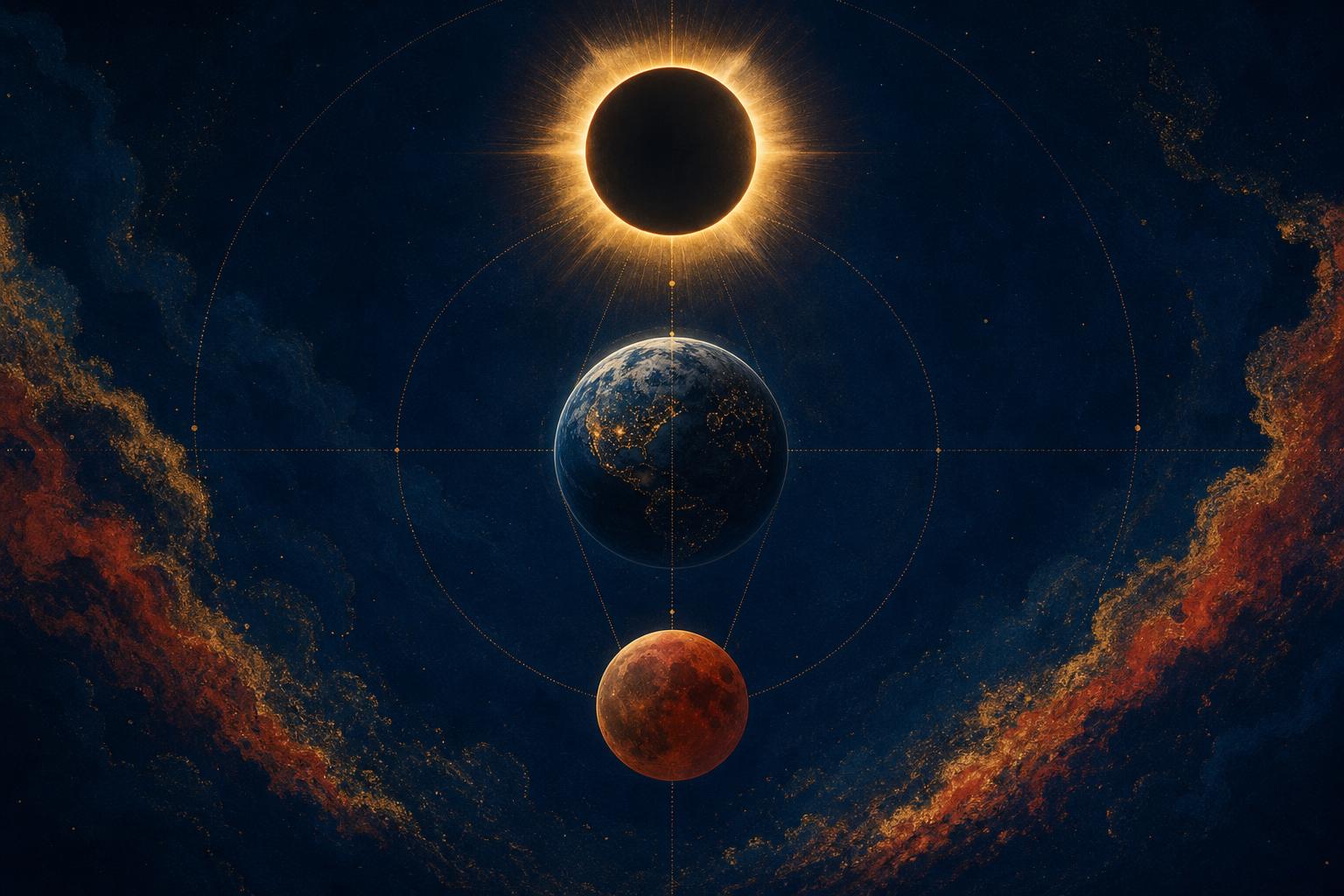
The eclipses draw attention because they change, briefly, the way we look at the sky. In astrology, they are often associated with beginnings, endings and moments of awareness. In astronomy, however, an eclipse is a calculable phenomenon produced by the alignment of the Sun, Earth and Moon. The two perspectives may coexist, provided they are not confused.
What is the difference between the solar eclipse and the moon eclipse?
A solar eclipse occurs in New Moon, when Moon passes between Earth and the Sun and designs a shadow on one side of the planet. Observers in the right area can see a total eclipse, partial or ring, depending on their position and the apparent distance between the Moon and the Sun.
A lunar eclipse occurs at Full Moon, when the Earth lies between the Sun and the Moon, and the shadow of the Earth falls on the lunar surface. It may be penumbral, partial or total. Unlike the solar eclipse, the lunar eclipse can be seen with the naked eye without the same risk to vision. ([science.nasa.gov] (https: / / science.nasa.gov / ECLIPSES /? utm _ source = openai)
Eclipses don’t occur at every New Moon or Full Moon, because the moon’s orbit is tilted to the plane of Earth’s orbit. The stars need to get close enough to the points where the two planes intersect.
How are they interpreted in astrology?
In astrology, the solar eclipse is symbolically linked to themes such as identity, personal direction, initiative and how a person asserts his will. For a reader, it can become an opportunity to ask: What do I want to start and what image of me doesn’t fit me anymore?
The lunar eclipse is associated, in astrological interpretations, with emotions, memory, attachments and things that surface. The useful question can be: What am I delaying to admit or what stage does it need a natural closure?
These associations relate to the symbolic language of astrology, not to proven effects on personality or events. An eclipse does not oblige anyone to make a decision, it does not guarantee a change and it cannot safely predict a breakup, promotion or gain.
What limits do astrological interpretations have?
The first limit is generalization. The fact that two people have the same sign does not mean they will live the same eclipse in the same way. An astrological interpretation may take into account the native map, but even then it remains a symbolic reading, not a diagnosis and no experimentally verified forecast.
The second limit is the tendency to turn a spectacular phenomenon into a verdict. Forms like “eclipse changes your life” or “you’re not allowed to start anything” can create fear and dependence on horoscope. A healthier approach uses the eclipse as a context of reflection, not as an authority that decides for you.
For example, if a lunar eclipse coincides with a tense time at work, it does not prove that the stars caused conflict. It can only be a moment when you see your fatigue, your limits or your need for change more clearly. The decision must be based on facts, discussions and real consequences.
2026 Eclipses: what is verifiable
The astronomical calendar for 2026 includes four eclipses: an eclipse of the Sun on February 17, a total eclipse of the Moon on March 3, a total eclipse of the Sun on August 12 and a partial eclipse of the Moon on August 28, the data being presented by NASA in Universal Time. Visibility differs depending on the region, so the date of an eclipse does not automatically mean that the phenomenon can be observed from Romania. ([eclipse.gsfc.nasa.gov] (https: / / eclipse.gsfc.nasa.gov / OH / OH2026.html? utm _ source = openai)
The total solar eclipse of 12 August 2026 will cross, among other regions, Greenland, Iceland, northern Russia and Spain; in other areas it will be seen only partially or at all. ([science.nasa.gov] (https: / / science.nasa.gov / eclipses / future-eclipses / total- solar-eclipse-one-august- 12-2026 /? utm _ source = openai)
For solar comments, safety is essential: The sun should not be looked directly without special protection for eclipses. Ordinary sunglasses, improvised filters or eyes through unprotected appliances do not provide sufficient protection. ([science.nasa.gov] (https: / / science.nasa.gov / ECLIPSES /? utm _ source = openai)
How can you use an eclipse without exaggerating its meaning?
- Write down what happens in your life, without immediately seeking a cosmic explanation.
- Use astrological symbols for questions, not verdicts.
- Delay impulsive decisions if you feel overwhelmed.
- Check astronomical information before planning observations or trips.
You can look at astrology as a reflection language along with other personal instruments. For a broader perspective on how zodiac symbols are read, you can also consult the guide on zodiac signs. And if you want to compare this approach to how horoscope is used in everyday life, you find examples in the article about why we read the horoscope.
In conclusion, the eclipse is first a celestial phenomenon, and then can become a personal symbol. The value of an interpretation is not in the promise that it will tell the future, but in the good questions it can open.