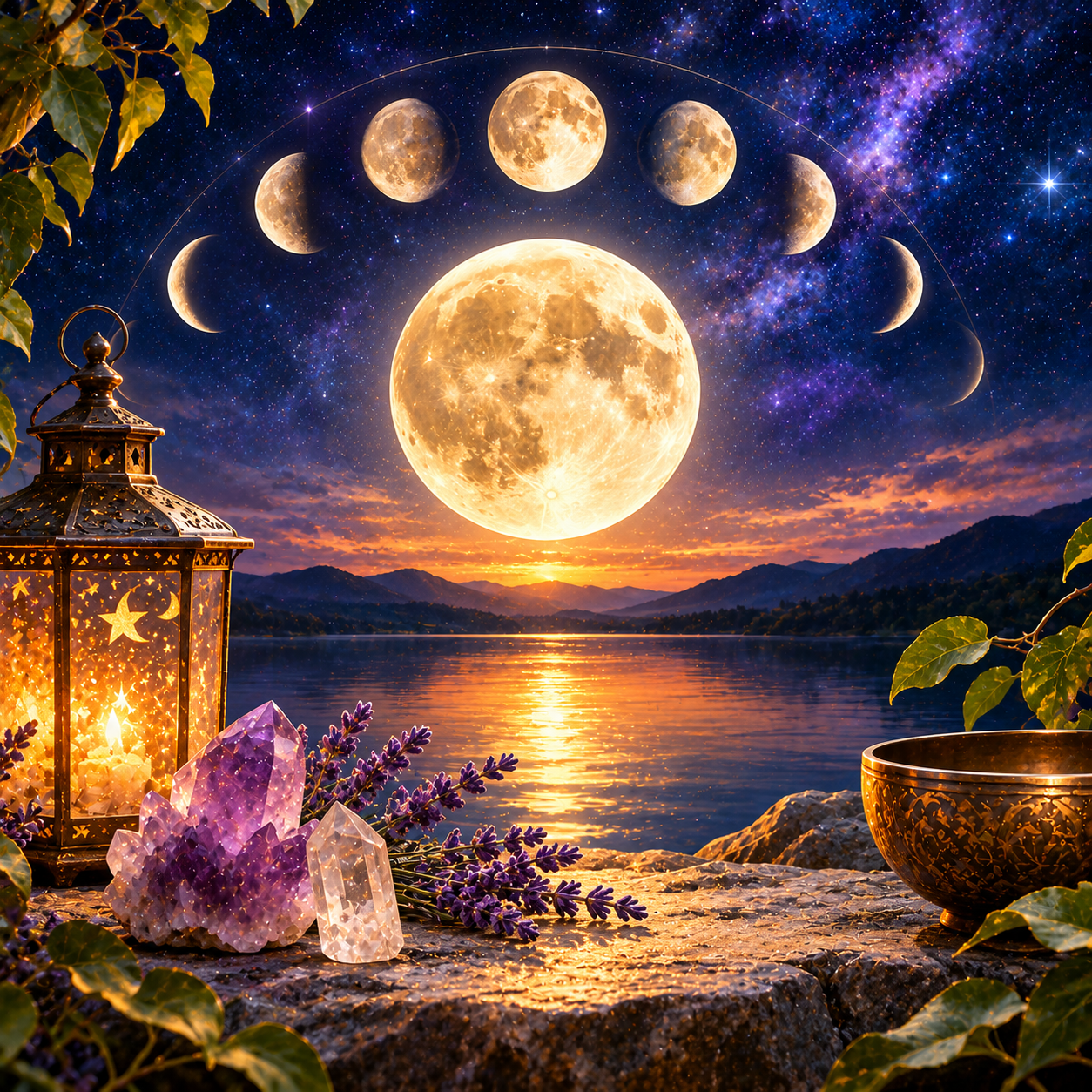
The moon is the easiest to see a heavenly body: every month you see it grow, become full and then shrinking. In astrology, these phases have been used for centuries as a symbolic calendar of beginnings, culminations and endings. Astronomical, the phases are the result of a simple thing: as far from the Moon as the sun can see from the Earth.
In the guide you will find out why there are phases, how long a cycle lasts, what symbolically means Moon new and Moon full, how it binds to signs, what eclipses are and what science says about the influence of the Moon on people.
Why does Moon have phases
The moon does not have its own light; it reflects the sunlight. Half of it is always lit up, but looking from Earth we see different proportions from the bright side, depending on the angle of the Sun-Earth-Moon. It has nothing to do with the shadow of the Earth: it appears only at the lunar eclipses.
A complete cycle of phases (synodic month) lasts on average 29.53 days. It is longer than the time Moon makes a detour of the Earth from the stars (about 27.3 days), because in the meantime the Earth has moved into orbit around the Sun, and Moon has to catch up with the Sun.
The eight main phases
| Phase | What do you see? | Position towards the Sun |
|---|---|---|
| New Moon | You can’t see | in conjunction with the Sun (approx. 0 °) |
| Ascending crescent crescent | thin, at sunset | approx. 45 ° east |
| First Quarter | half-light, evening | 90 ° east |
| Increasing gibous moon | more than half | approx. 135 ° |
| Full Moon | The whole disk, all night a | opposition to the Sun (180 °) |
| Decreasing gibous moon | drop after midnight | approx. 225 ° |
| Last Quarter | half-light, morning | 270° |
| Decreased crescent crescent | thin, before sunrise | approx. 315 ° |
Notice the link with aspects: The new Moon is a Sun-Moon conjunction, the first square one square, the full moon one opposition, and the last square another square.
New Moon in Astrology
It’s when the Sun and Moon are at the same level of the zodiac. Symbolic, it’s a start: a white page, a moment for intentions, projects, what you want to start. The mark of the new Moon is the theme of the moon. For example, a new moon in Taurus is read as an urge to stability and resources, one in Gemini as an invitation to learning and communication. It’s an interpretation convention, not a guarantee.
Moon full in astrology
At full Moon, the Sun and Moon are in opposition, in opposing signs. Symbolic, it’s a culmination: what started at Moon Nine shows its result, and emotions are considered more intense. In popular culture, it is said that full Moon brings unrest and agitation. Studies that tested this are not conclusive: some find small differences in sleep, some find nothing.
Rising and decreasing phases
- Rising month (from nine to full): symbolic, time to build, start, accumulated.
- Decreasing month (from full to nine): symbolic, time to complete, cleaned, left behind.
Many people use the monthly cycle as a planning ritual: a list of intentions at Moon Nine and an evaluation at Moon Full. Even if you don’t believe in the influence of the Moon, the rate of a month is a good frequency for personal balance sheets.
Moon nine and Moon full fall into a sign
Because the new Moon takes place with the Sun and Moon at the same sign, it is always in the sign that the Sun is at that moment. So a new moon in August is in Leo or Virgo. Full Moon takes place in the opposite sign: if the Sun is in Leo, full Moon is in Aquarius. That’s why every year the 12-13 new months go through the zodiac.
Eclipses
Eclipses occur when a new or full moon occurs near one of the lunar nodes, i.e. the points where the moon’s orbit intersects the ecliptic plane. At Moon Nine there can be an eclipse of the Sun and at Moon full of Moon. Not every new moon produces eclipse because the moon’s orbit is tilted approximately 5 ° to the ecliptic. Within one year, at least four eclipses appear (two of the Sun and two of the Moon) and at most seven.
In astrology, eclipses are considered moments of “reset” and are symbolically associated with changes in direction. Astronomical observations are precise: eclipse data are calculated years before.
Moon in signs and phase of the Moon at birth
The Moon mark in your home map is different from her phase. The phase of the Moon at birth describes, in some schools, a person’s “rhythm”: born on Moon nine, symbolic “beginner”; born on Moon full, symbolic “in search of balance.” It’s a choice of interpretation, not a rule. For the sign of the Moon, see the article on the three signs.
What science says about the influence of the Moon
The moon influences tides through gravity, and the effect on water in the human body is negligible. Extensive research on births, accidents, crime or behavior depending on the Moon stage found no stable links. Popular beliefs probably persist because of the bias of confirmation: we remember the busy night at full Moon and forget the other nights.
How you use the monthly cycle basically
- Write down the date of the new moon in a calendar.
- Write two-three simple intentions for the next month.
- At Full Moon, recite them and see what worked.
- At the next new moon, close the cycle and start another.
For concrete days, you can follow the astrological calendar on the site.
How do you recognize the phase of the Moon without the calendar
There is a simple trick: if Moon looks like a letter “D” (the bright side to the right, looking from the northern hemisphere), it’s growing; if it looks like a “C,” it’s decreasing. The rising moon is seen in the evening, toward the sunset, and the rising moon in the morning towards the sunrise. Full moon rises at sunset and sets at sunrise, so it’s visible all night.
Moon in signs: why change every two and a half days
The month goes through the 12 signs in a cycle of approximately 27.3 days, so it stays about 2.3 days each. If you take this into account, the phase cycle and the sign cycle slowly desynchronise: each new moon falls into a different sign, and after about 12-13 cycles returns into the same sign. You can see the rhythm in an astrological calendar, watching the sign every full moon falls.
If you want to check yourself, go out in the evening, look at Moon and compare with the table above: in a few months you’ll recognize the phase of a look without applications.
Common
- The confusion between the moon phase and the sign of the moon. The phase says how bright it is; the sign says which side of the zodiac it is in.
- The belief that eclipses are “bad.” They are regular astronomical phenomena with predictable rhythm.
- Using the wrong time zone. The exact moment of the new moon is usually given in UTC; in Romania you add two or three hours.
- Too high expectations. The monthly ritual helps if you are constant, not because of the Moon itself.
Frequently asked questions
Why don’t we see Moon nine?
Because the bright side is pointing towards the sun, and we see the dark side. In addition, Moon Nine rises and sets almost with the Sun.
What’s a blue moon?
The second full moon of a calendar month. It appears about every two and a half years and has no special astronomical significance.
What’s supermoon?
A full moon that takes place when Moon is close to the point closest to the Earth (perigee); appears slightly larger and brighter.
The moon influences sleep?
Some small studies suggest minor differences, others do not; the evidence is not consistent.
Astrology is a symbolic system, not a science. The lunar phases and eclipses are verifiable astronomical phenomena.