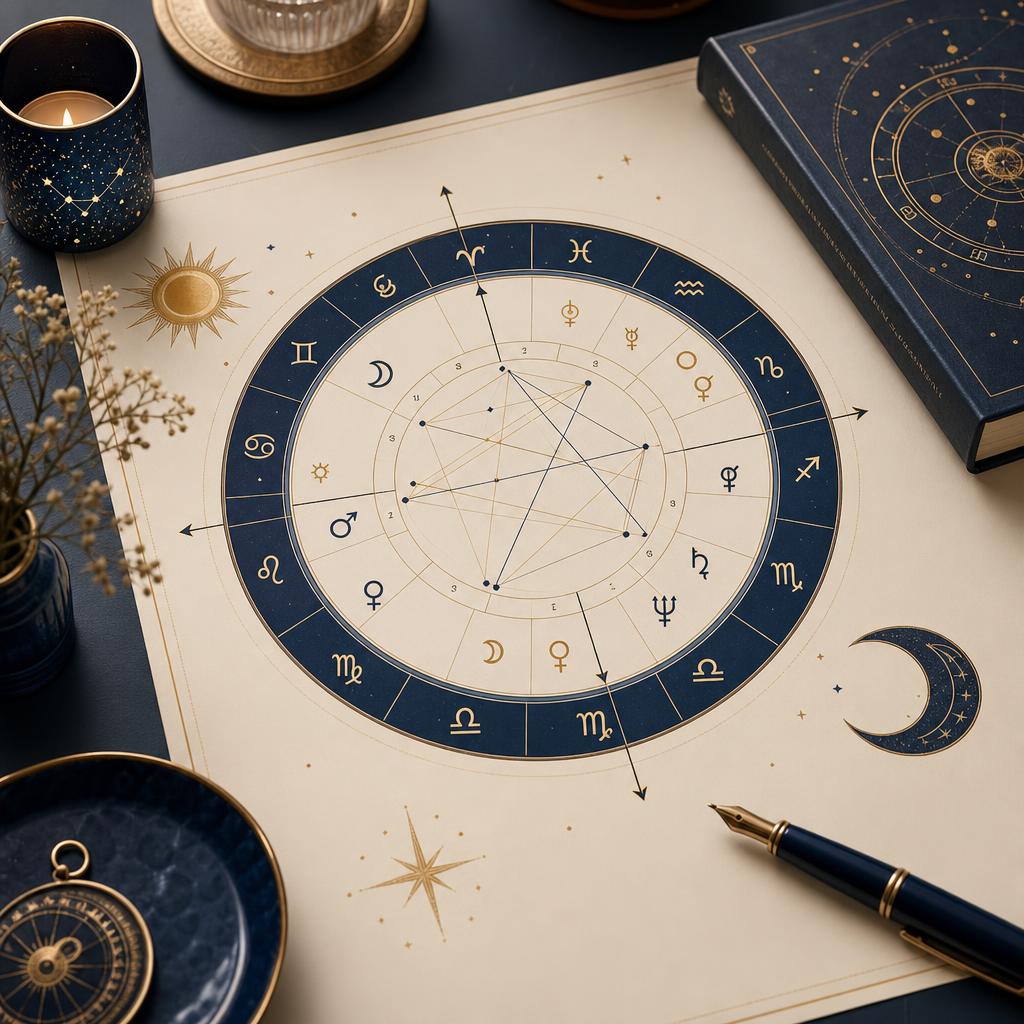
How to read a native map is one of the most common questions for who starts studying astrology. A circle full of symbols may seem complicated, but the reading becomes clearer if you follow a simple order: you check the birth dates, you identify the Sun, Moon and Ascendant, then you look at the planets, the houses and the aspects between them.
Astrology must be seen here as a symbolic language and a reflection instrument, not as a scientific method of diagnosis or as a safe form of prediction. A native map does not determine your destiny or replace your own choices.
1. Check birth dates
For the calculation of a birth map, the date, time and place of birth are usually used. The class is especially important for Ascendant and for house division. If the time is approximate or unknown, the interpretation of these elements becomes less certain.
Before analyzing the map, note your home system used by the astrological computer. Different systems can sometimes place a planet in a different home. It is not a reason to immediately seek a “correct ‘interpretation; it is more useful to keep the same method and to observe how the symbols link together.
2. Start with “Big Three”
The first three positions worth reading are the Sun, Moon and Ascendant. Together, it offers a more nuanced starting point than the mere sun sign.
- The sun is associated, in astrology, with its identity, personal direction and the way you express your will.
- Month is symbolically related to emotional reactions, safety needs and emotional habits.
- Ascendant describes how you enter new situations, first impression and style by which you present yourself to the world.
Don’t interpret them separately as three rigid labels. For example, a person with the Sun in Taurus, Moon in Gemini and Ascendant in Scorpio can combine stability and patience with a curious mind and a more reserved or intense appearance. The example is not a mandatory description, but a way to see how different themes can coexist.
For a separate explanation of the Ascendant role, you can consult the Ascendant Guide .
3. Read each planet through two questions
A simple rule for beginners is to separate the function of the planet from the way in which it is expressed:
- Planet answers the question “what function or theme is active? ‘.
- The sign shows “how is this topic expressed? ‘.
- House suggests “in what area of life is it observed? ‘.
For example, Mercury in Leo in the third house can be symbolically read as a more expressive communication, visible in conversations, learning or relationship with the immediate environment. It doesn’t mean that the person will always communicate the same and that one position explains the whole character.
At first, focus on the Sun, the Moon, Mercury, Venus and Mars. Slow planets can provide generational themes, but are harder to interpret without the rest of the map.
4. Understand the role of houses
Houses are the twelve sections of the map and are used to organise areas of experience. In short, the first houses relate to identity, resources, communication and family; the middle area houses achieve creativity, routine, relationships and common resources; the last houses refer, in astrological language, to meaning, career, groups and inner life.
There’s no need to memorize all associations in the first place. Choose an important planet and wonder where it is. Venus in the seventh house, for example, is symbolically interpreted through topics of approach, cooperation and partnership. Venus in the tenth house can move the focus to public image, professional values or the relationship with the appreciation of others.
5. Look at the issues without turning them into a verdict
Lines at the centre of the map indicate aspects, i.e. angular relationships between planets. In astrological interpretation, some are seen as more fluid and some as more tense. A tense aspect does not automatically mean “bad ‘; it may describe a contradiction, pressure or an area where the person learns to negotiate two needs.
For example, a difficult aspect between Mercury and Saturn can be read as caution in expression, self-criticism or need of structure in thinking. For someone else, the same symbolism can become discipline and concentration. The context matters more than an isolated interpretation.
A simple working method
- Write down the Sun, Moon and Ascendant.
- Choose two personal planets and observe their sign and home.
- Search for a repeated theme: many planets in an element, in a hemisphere or in an area of the map.
- Analyze at most two important issues.
- Compare interpretation with real experience without forcing the match.
A native map is read better as a set of symbols than as a collection of predictions. If an interpretation sounds absolutely scary or tells you you can’t change anything, it’s worth looking at with caution. You can use astrology for questions and reflection, keeping important decisions in your own hands.